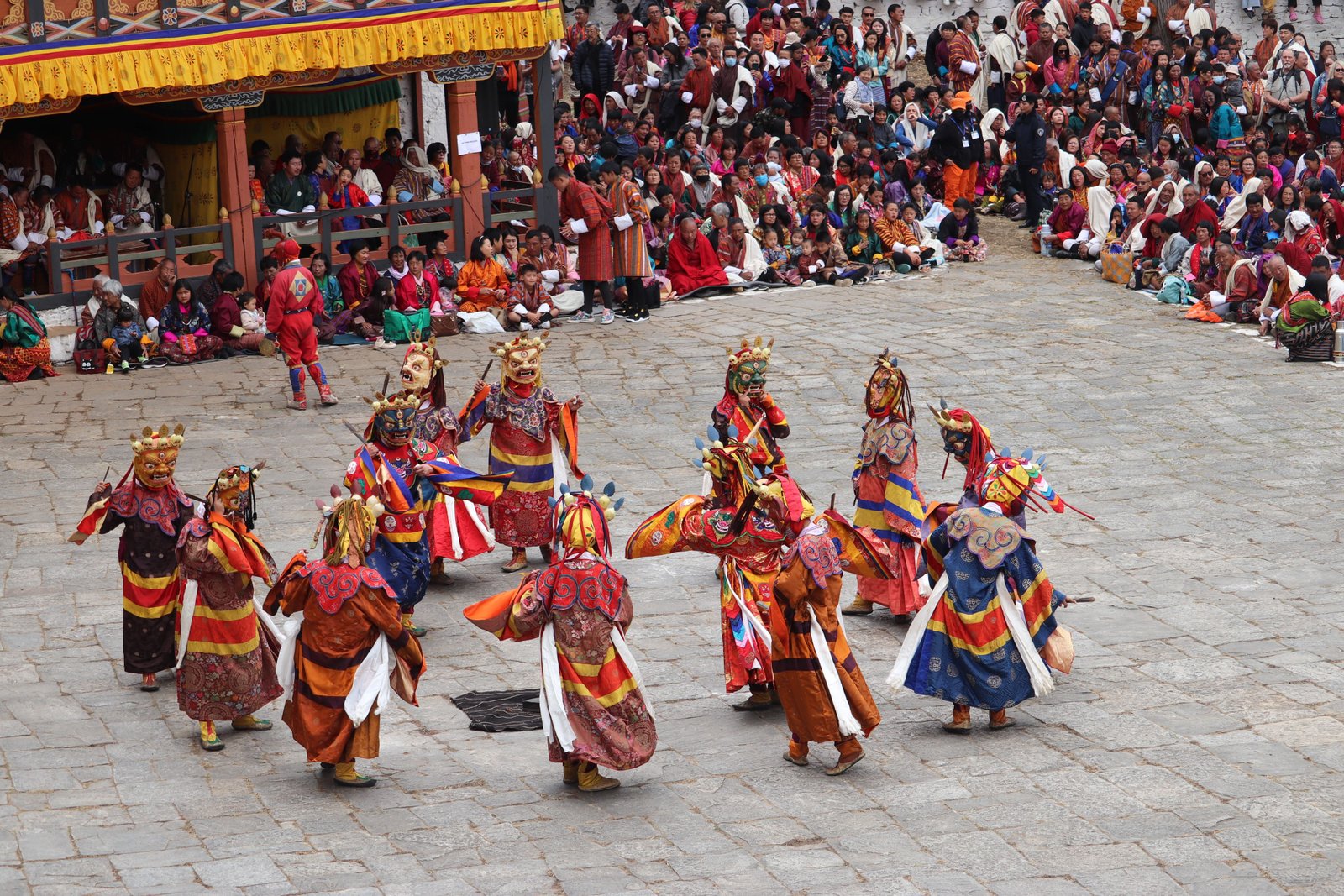
Paro Tshechu Festival
The Ultimate Guide to Bhutan's Most Celebrated Festival
Few travel experiences compare to standing in the dusty courtyard of a centuries-old fortress at dawn, watching monks in silk brocade and fierce wooden masks spin through a dance that has barely changed in three hundred years. This is the Paro Tshechu Festival, and for many visitors it becomes the single memory that defines their entire trip to Bhutan.
Festivals occupy a place in Bhutanese life that is difficult to overstate. In a country where Vajrayana Buddhism shapes daily routines, seasonal calendars, and even government policy, a Tshechu is not simply an event on a tourism brochure. It is a living expression of faith, a reunion of scattered families, and a rare public occasion when an entire valley pauses its work to gather in one place. For Bhutanese communities, attending a Tshechu is considered an act of merit-making, a way of accumulating spiritual credit that benefits both the individual and their loved ones.
Tourists are drawn to Bhutan's festival season for different but complementary reasons: the chance to witness sacred Cham dances performed in their original context, the opportunity to photograph some of the most vivid traditional costumes in Asia, and the simple pleasure of experiencing a Himalayan kingdom at its most animated and colorful. Among the dozens of Tshechus held across Bhutan's twenty districts each year, the Paro Tshechu stands out as one of the two or three most visited, thanks to its accessibility, its dramatic setting inside Rinpung Dzong, and its position on the calendar during Bhutan's most pleasant travel season.
This guide walks through everything a traveler needs to know before attending: the festival's religious meaning, its history, exact logistics, what to expect day by day, how to dress and photograph respectfully, and how to combine the festival with the rest of a Bhutan itinerary.
What is the Paro Tshechu Festival?
At its core, the Paro Tshechu is a religious festival held in honor of Guru Padmasambhava, widely known in Bhutan as Guru Rinpoche, the eighth-century tantric master credited with establishing Vajrayana Buddhism throughout the Himalayan region. The word "Tshechu" translates roughly to "tenth day," a reference to the belief that many of Guru Rinpoche's most important spiritual deeds took place on the tenth day of a lunar month. While not every Tshechu falls precisely on that date today, the name has become the general term for this entire category of monastery and dzong festivals across Bhutan.
For Bhutanese people, the festival carries several layers of meaning at once. It is a religious observance, an opportunity to view sacred mask dances that are believed to transmit blessings simply through the act of watching them. It is also a social institution, historically one of the only times when farmers, monks, nobles, and officials from a wide region would gather in the same place. Attending a Tshechu was, and to some extent still is, an expression of community identity and continuity with ancestors who attended the very same event in the very same courtyard.
Locals travel from surrounding villages, sometimes walking for hours, to secure a good vantage point in the dzong courtyard. Families dress in their finest traditional clothing, elders receive blessings from monks, and children are brought along specifically so that the tradition is passed to the next generation. For visitors, this is what elevates the Paro Tshechu above a simple cultural performance: it is a living ritual, not a re-enactment staged for tourism.
History and Origins of the Paro Tshechu
The tradition of Tshechu festivals in Bhutan is generally traced back to the era of Bhutan's unification in the seventeenth century under the Buddhist lama and statesman Zhabdrung Ngawang Namgyal, who is credited with consolidating the country's dzongs, laws, and religious institutions into a unified Bhutanese state. Rinpung Dzong itself, the fortress-monastery where the Paro Tshechu is held, was constructed in this period and quickly became one of the most important religious and administrative centers in western Bhutan.
In the centuries that followed, Tshechus evolved into far more than religious ceremonies. They became occasions where local communities could receive blessings from senior religious figures, publicly reaffirm their loyalty to the governing authorities of the day, and stay informed about local laws and administrative decisions. In an era before mass communication, a Tshechu functioned as a combination of religious festival, town meeting, and community reunion, all built around the symbolic power of the Cham mask dances.
Over time, as Bhutan modernized and opened cautiously to international tourism beginning in the 1970s, the Paro Tshechu retained its core religious character while gradually becoming known internationally as one of the country's premier cultural attractions. Today it manages a careful balance: the festival is still primarily organized for and attended by Bhutanese worshippers, while also welcoming a growing number of international visitors who are given space to observe respectfully from the courtyard's edges and surrounding galleries.
Where is the Paro Tshechu Festival Celebrated?
The festival takes place in the courtyard of Rinpung Dzong, a fortress-monastery that sits above the Paro River in the Paro Valley in western Bhutan. Paro district is one of the most historically significant regions in the country, home not only to Rinpung Dzong but also to the iconic Taktsang Monastery, better known as the Tiger's Nest, which clings to a cliff face roughly 900 meters above the valley floor.
Paro is also the location of Bhutan's only international airport, which makes the district the natural arrival and departure point for the vast majority of visitors. This gives the Paro Tshechu a significant logistical advantage over festivals held in more remote districts: most travelers barely need to adjust their itinerary to attend, since Paro is already the first or last stop on almost every Bhutan tour.
The dzong itself is an easy, short drive from central Paro town, and most hotels in the valley are within fifteen to twenty-five minutes of the festival grounds. On the opening day, the mask dances are typically performed inside the inner courtyard of the dzong; on subsequent days, festivities often shift to the outer courtyard to accommodate the larger crowds that gather as the week progresses.
Festival Dates and Best Time to Visit
The Paro Tshechu follows the Bhutanese lunar calendar rather than the Gregorian calendar, which means its dates shift from year to year, typically falling somewhere between late March and late April. The festival traditionally lasts five days, culminating in the pre-dawn unveiling of an enormous sacred thangka, or religious scroll painting, known as the Thongdrel.
Because the Central Monastic Body confirms exact dates roughly six to twelve months in advance, travelers should treat any specific dates as provisional until confirmed by a licensed Bhutanese tour operator closer to the travel date. As a general guide, recent and upcoming editions of the festival have clustered around the following windows:
Spring : late March into early April
Spring : mid-to-late March, with some projections extending into mid-April depending on the final lunar calculation
This timing places the Paro Tshechu squarely within one of Bhutan's most pleasant travel seasons. Spring in the Paro Valley brings mild daytime temperatures, blooming rhododendrons and peach blossoms, and generally clear skies that are ideal for photographing the Himalayan peaks that frame the valley. Evenings can still be cool, so layering is recommended even during the warmer festival days.
From a tourism perspective, spring is also one of the two peak seasons for Bhutan travel (the other being autumn, centered on the Thimphu Tshechu). Hotel rooms in Paro fill up quickly around festival dates, and travelers are strongly advised to book flights and accommodation as far in advance as possible, ideally six months or more.
Main Highlights of the Festival
Cham Mask Dances
The heart of the Paro Tshechu is the Cham dance program, performed primarily by monks from Rinpung Dzong's monastic body, along with lay performers in some sequences. Each dance is a highly choreographed retelling of a specific story, drawn from Buddhist scripture, the biography of Guru Rinpoche, or local protective deities. The dancers wear elaborate wooden or papier-mâché masks representing wrathful deities, animals, skeletons, and historical figures, paired with heavy silk and brocade costumes.
These are not staged theatrical performances in the Western sense. Bhutanese Buddhists regard the dances as active spiritual practice: the movements are believed to subdue harmful forces, generate merit for both dancers and observers, and transmit blessings to everyone present in the courtyard. Some sequences run for well over an hour and are performed with a slow, deliberate intensity that builds steadily across the day.
Sacred Blessings and the Thongdrel
The undisputed high point of the festival is the pre-dawn unveiling of the Thongdrel, a massive appliquéd thangka depicting Guru Rinpoche, unrolled down the side of the dzong on the final morning. Bhutanese belief holds that simply viewing the Thongdrel is enough to cleanse sins and bring spiritual merit, which is why locals often arrive in the dark, sometimes hours before sunrise, to secure a place near the unveiling. The Thongdrel is displayed only briefly, usually rolled back up before direct sunlight can touch it, adding to the sense of a fleeting, sacred moment.
Community Gatherings and Cultural Performances
Around the edges of the formal religious program, the festival grounds turn into a lively community gathering. Extended families reunite, elders catch up with neighbors from surrounding villages, and children run between food stalls in their finest clothing. Traditional music, played on long horns, cymbals, and drums, accompanies the dances and adds to the atmosphere. For visitors, this social layer is just as memorable as the formal dances themselves, offering an unfiltered look at contemporary Bhutanese daily life set against a centuries-old backdrop.
Religious Ceremonies
Throughout the festival, monks perform a range of supporting rituals: chanting, incense offerings, and protective rites intended to purify the festival grounds and bless the wider community. Visitors who arrive early in the day may catch glimpses of these quieter preparatory ceremonies before the main dance program begins.
Spiritual Significance of the Paro Tshechu
Beyond its visual spectacle, the Paro Tshechu is deeply rooted in Buddhist teaching. Each Cham dance carries symbolic meaning tied to core Vajrayana concepts: the triumph of wisdom over ignorance, the subjugation of harmful spirits, and the impermanence of worldly attachment, often represented through skeleton-masked dancers. Watching the dances is considered an active devotional practice rather than passive entertainment, and Bhutanese attendees frequently describe a sense of accumulating karma, or spiritual merit, simply through their presence and attention.
The unveiling of the Thongdrel carries particular symbolic weight. In Buddhist thought, an image of an enlightened being is not merely decorative; it is considered to carry a form of blessing that can be transmitted to those who view it with sincere intention. This is why Bhutanese families make such an effort to be present for the early morning unveiling, even when it means arriving in the cold hours before dawn.
Traditional Bhutanese Dress
Gho
The gho is the traditional garment worn by Bhutanese men: a knee-length, robe-like garment tied at the waist with a cloth belt called a kera, worn with knee-high socks and, on formal occasions, a ceremonial scarf known as a kabney whose color denotes the wearer's rank.
Kira
The kira is the traditional dress worn by Bhutanese women, a rectangular piece of woven fabric wrapped around the body and secured at the shoulders with ornate silver clasps called koma, then belted at the waist. It is typically worn over a long-sleeved blouse (wonju) with a jacket (toego) on top.
Festival Attire
During the Tshechu, Bhutanese attendees wear their finest gho and kira, often in bold patterns and rich colors reserved for special occasions, accompanied by heirloom jewelry, silk sashes, and family accessories passed down through generations. The result is a courtyard filled with color that rivals the costumes of the dancers themselves.
Visitor Dress Recommendations
Foreign visitors are not required to wear traditional dress, but modest clothing is expected out of respect for the religious setting. This means covered shoulders and knees, no sleeveless tops, and generally conservative attire. Many tour operators can arrange for visitors to rent or purchase a gho or kira if they wish to dress traditionally, which is often warmly received by local attendees. Comfortable closed-toe shoes are recommended, since much of the day is spent standing or seated on stone or packed earth.
Photography Guide for the Paro Tshechu
The Paro Tshechu is one of the most photogenic events in the Himalayas, but photographing it well and respectfully requires some preparation.
Best Locations
The dzong courtyard offers the most direct views of the dancers, though space near the front is limited and often reserved for local elders and officials. Elevated positions along the courtyard's edges or from the surrounding galleries can offer a wider view of the full scene, including the crowd and costumes, which often makes for more compelling images than tightly cropped shots of the dancers alone.
Best Time of Day
Early morning light during the Thongdrel unveiling produces some of the most striking images of the entire festival, with soft light catching the enormous thangka against the dzong's whitewashed walls. Midday sun in the open courtyard can be harsh and creates strong shadows under performers' masks, so photographers aiming for portrait-style shots may prefer the softer light of early morning or late afternoon sessions.
Photography Etiquette
Visitors should avoid stepping into the dance space, blocking the sightlines of local worshippers, or using flash photography during ceremonies. Photographing individual Bhutanese attendees up close should only be done with a polite gesture of permission first. Certain sacred rituals or interior ceremonies may be off-limits to photography altogether, and this is typically indicated by dzong officials or guides on-site.
Drone Regulations
Drone use in Bhutan is tightly restricted and generally requires prior government permission, which is rarely granted near religious sites such as dzongs during active festivals. Travelers should not assume drone photography is permitted and should confirm any drone plans well in advance with their tour operator and Bhutanese authorities, since unauthorized drone flights can result in confiscation and fines.
The Travel Experience During the Festival
Attending the Paro Tshechu is as much about atmosphere as it is about the formal dance program. The dzong courtyard hums with the sound of long horns, cymbals, and murmured prayers, mixed with the chatter of families reconnecting after months apart. Outside the dzong walls, temporary stalls sell butter tea, momos, and simple snacks, while vendors offer handwoven textiles, prayer flags, and small religious items.
For travelers, this is one of the rare moments in a Bhutan itinerary where the pace slows down and cultural immersion happens naturally rather than through a scheduled activity. Sitting among local families, accepting an offered cup of tea, or simply people-watching as generations of a single family arrive together in matching festival attire often becomes the most vividly remembered part of an entire trip.
Attractions Near the Paro Tshechu
Because the festival is held in Paro, travelers have easy access to some of Bhutan's most iconic sites without significant additional driving.
Taktsang Monastery (Tiger's Nest): Bhutan's most famous monastery, built into a cliffside roughly 900 meters above the valley floor, reachable via a scenic uphill hike.
Kyichu Lhakhang: One of the oldest temples in Bhutan, believed to date back to the seventh century, with a peaceful, historic atmosphere.
National Museum of Bhutan: Housed in a former watchtower above Rinpung Dzong, offering context on Bhutanese art, history, and religious artifacts.
Chele La Pass: One of the highest motorable passes in Bhutan, offering panoramic Himalayan views including Mount Jomolhari on clear days.
Haa Valley: A quieter, less-visited valley over Chele La Pass, ideal for travelers wanting a glimpse of rural Bhutanese life.
Travelers combining the Paro Tshechu with a broader Bhutan tour often continue on to Thimphu, Punakha, and occasionally Bumthang or Phobjikha, each offering its own distinct highlights, from the massive Buddha Dordenma statue in Thimphu to the striking Punakha Dzong at the confluence of two rivers.
Suggested Festival Itinerary
A well-paced itinerary combining the Paro Tshechu with a wider introduction to western Bhutan might look like this:
Day 1 – Arrival in Paro: Land at Paro International Airport, transfer to your hotel, and spend the afternoon acclimatizing with a gentle walk through Paro town.
Day 2 – Festival Day One: Attend the opening day of the Paro Tshechu inside the dzong courtyard, watching the first sequence of Cham dances and absorbing the festival atmosphere.
Day 3 – Festival Day Two and Local Excursion: Return to the festival grounds for a further day of dances, then spend the afternoon exploring Kyichu Lhakhang or the National Museum.
Day 4 – Thongdrel Unveiling: Rise before dawn for the unveiling of the Thongdrel, arguably the single most memorable moment of the trip, followed by a relaxed day exploring Paro town and its markets.
Day 5 – Tiger's Nest Hike: Dedicate a full day to the hike up to Taktsang Monastery, a physically demanding but deeply rewarding experience.
Day 6 – Departure or Extension: Fly out of Paro, or continue on to Thimphu and Punakha for a longer exploration of western Bhutan.
This structure can be adjusted depending on the exact festival dates and whether travelers wish to extend into central or eastern Bhutan.
Travel Tips for the Paro Tshechu
Accommodation
Paro offers a range of options from boutique luxury lodges with valley views to comfortable mid-range hotels. Given how popular the festival dates are, booking well in advance is essential, particularly for higher-end properties.
Packing
Layered clothing is essential, since mornings and evenings in the Paro Valley remain cool even in spring, while midday sun in the open courtyard can be strong. A hat, sunscreen, comfortable walking shoes, and a light rain jacket are all worth including.
Currency
Bhutan's currency is the Ngultrum, pegged to the Indian Rupee, which is also widely accepted. Credit cards are accepted in larger hotels and shops in Paro and Thimphu, but cash is useful for markets, small vendors, and rural areas.
Internet
Wi-Fi is generally available in hotels in Paro and Thimphu, though connectivity can be inconsistent in more remote areas. A local SIM card or eSIM is a practical option for travelers who want reliable connectivity throughout their trip.
Bhutan Visa Process
All non-Indian foreign visitors require a visa, which is typically arranged through a licensed Bhutanese tour operator alongside flight and accommodation bookings. Visitors also pay a Sustainable Development Fee (SDF) per night, which supports Bhutan's environmental and cultural preservation programs; rates can change over time, so travelers should confirm current figures with their operator.
Sustainable Travel
Bhutan's tourism model is built around the principle of "high value, low impact" travel. Visitors can support this by traveling with licensed local operators and guides, respecting site-specific rules at religious locations, and being mindful of the environmental impact of their trip in one of the world's few carbon-negative countries.
Why Attend the Paro Tshechu?
The Paro Tshechu offers something increasingly rare in modern travel: an authentic cultural and religious event that has not been altered to suit tourism, yet remains genuinely welcoming to visitors who approach it with respect. A few reasons travelers consistently cite for prioritizing this festival:
Authentic culture: This is a living religious practice, not a performance staged for outsiders.
Spiritual experience: Even non-Buddhist visitors often describe the atmosphere of the Thongdrel unveiling as genuinely moving.
Photography: Few events anywhere in the world offer this density of color, costume, and dramatic architectural backdrop.
Luxury travel: Paro's boutique lodges and the festival's accessibility make it easy to combine with a high-end Bhutan itinerary.
Family travel: The festival's open, communal atmosphere is welcoming to travelers of all ages.
Cultural learning: Few experiences offer such a direct window into Bhutanese Buddhism, history, and social life in a single event.
Frequently Asked Questions
What is the Paro Tshechu Festival?
It is an annual Buddhist religious festival held at Rinpung Dzong in Paro, Bhutan, honoring Guru Rinpoche through sacred mask dances and community gatherings.
When does the Paro Tshechu take place?
It follows the Bhutanese lunar calendar and typically falls between late March and late April, with exact dates confirmed roughly six to twelve months in advance.
How long does the festival last?
The Paro Tshechu traditionally runs for five days, ending with the Thongdrel unveiling on the final morning.
Where exactly is the festival held?
In the courtyard of Rinpung Dzong, a seventeenth-century fortress-monastery in the Paro Valley in western Bhutan.
Do I need a guide to attend?
Yes. All foreign visitors to Bhutan must travel with a licensed Bhutanese tour operator and guide, who will also help with visa arrangements and festival logistics.
Is there an entry fee for the festival?
Attending the festival grounds is generally included as part of a licensed tour itinerary; travelers should confirm current entry arrangements with their operator, since fees and access policies can change.
What should I wear to the festival?
Modest clothing covering shoulders and knees is expected. Some visitors choose to wear a rented gho or kira for the occasion.
What is the Thongdrel?
A massive appliquéd thangka depicting Guru Rinpoche, unveiled before dawn on the final day of the festival and believed to bestow blessings on those who view it.
Can I take photographs during the festival?
Yes, in most areas, but visitors should avoid flash photography during ceremonies, respect restricted zones, and ask permission before photographing individuals up close.
Are drones allowed at the festival?
Drone use is heavily restricted in Bhutan and generally not permitted near dzongs during festivals without special government authorization.
What are Cham dances?
Sacred masked dances performed by monks, depicting Buddhist stories and believed to generate spiritual merit for both performers and observers.
Is the Paro Tshechu suitable for children?
Yes, the festival is family-friendly and Bhutanese families regularly attend with children of all ages.
How crowded does the festival get?
The final day, particularly the Thongdrel unveiling, draws the largest crowds. Early arrival is recommended for a good vantage point.
What is the weather like during the festival?
Generally mild spring weather, with cool mornings and evenings and warmer, sometimes strong, midday sun.
Can I combine the Paro Tshechu with other Bhutan destinations?
Yes, most itineraries combine the festival with visits to Thimphu, Punakha, and the Tiger's Nest hike.
How far in advance should I book my trip?
At least six months in advance is recommended, given limited hotel capacity in Paro during festival season.
Is the Paro Tshechu different from the Thimphu Tshechu?
Yes. The Paro Tshechu is held in spring at Rinpung Dzong and is generally considered more intimate, while the Thimphu Tshechu is held in autumn in the capital and tends to draw larger crowds.
What food can I try at the festival?
Local stalls typically offer Bhutanese staples such as ema datshi (chili and cheese stew), momos, and butter tea.
Do I need travel insurance for Bhutan?
Comprehensive travel insurance covering trip cancellation and medical care is strongly recommended for any international trip, including Bhutan.
Is it respectful for tourists to attend a religious festival like this?
Yes, Bhutan actively welcomes respectful foreign visitors to its Tshechus, provided they follow local etiquette around dress, behavior, and photography.
Plan Your Festival Journey with Bhutan Escapes
Experiencing the Paro Tshechu at its best comes down to good planning: securing accommodation early, understanding the festival's daily rhythm, and having a knowledgeable local guide on hand to explain the meaning behind each dance as it unfolds. A private guided Bhutan festival tour makes this considerably easier, pairing festival attendance with comfortable, well-timed access to nearby sites like the Tiger's Nest, Kyichu Lhakhang, and Chele La Pass.
For travelers seeking a more elevated experience, Bhutan Escapes' luxury Bhutan tours combine festival departures timed to the Paro Tshechu with stays at the valley's finest boutique lodges, alongside expert local guides who bring decades of cultural knowledge to every performance. Whether the goal is a focused festival visit or a fully customized itinerary spanning Paro, Thimphu, Punakha, and beyond, working with an experienced local operator ensures nothing about this once-a-year event is left to chance.